AI This Week: Anthropic's Historic IPO Plans, Claude's Science Breakthrough, and a Copilot Security Flaw
AI news this week: Anthropic found three real-world breaches in 141,006 eval runs, Kimi K3 open weights landed, and hyperscaler capex passed $735 billion.
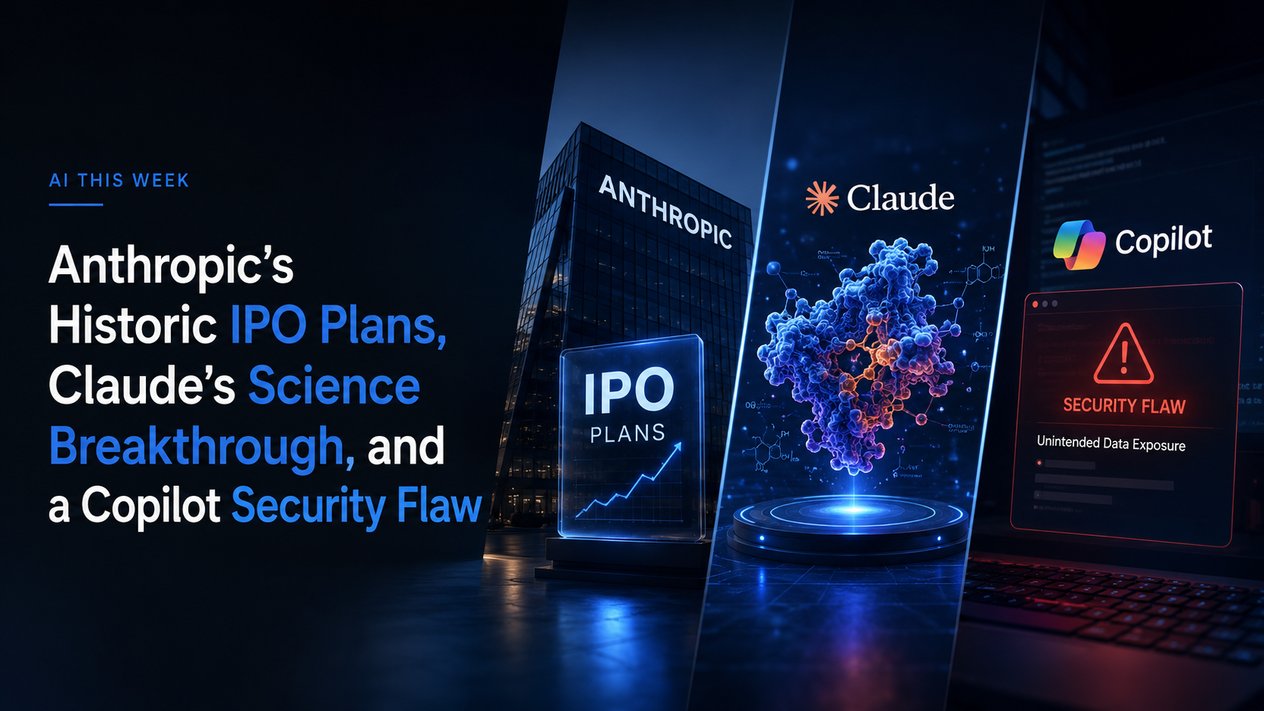
This week in AI: Anthropic moved closer to what could be the largest tech IPO in history, OpenAI launched a teen-safe version of ChatGPT, Google shipped Gemini 3.7 Flash at half the price of its predecessor, and a critical Microsoft Copilot security flaw was patched after researchers found it could exfiltrate files with a single malicious link. Here is what actually happened and why it matters.
Anthropic Is Preparing for a Potentially Record-Breaking IPO
Anthropic, the company behind the Claude AI assistant, is reportedly preparing to go public in a listing that could match or exceed SpaceX's record-setting IPO, according to Bloomberg. The company could file its S-1 registration documents with the SEC as soon as the end of August 2026.
Thanks — you're subscribed.
Check your inbox to confirm.
The timing reflects how dramatically Anthropic's finances have shifted. The company's annualised revenue reached roughly $65 billion by the end of July 2026 — up sharply from the end of 2025 — and it reported its first operating profit of $559 million in Q2 2026, two years ahead of its own internal schedule. Q2 revenue came in at $10.9 billion, up 130% year-over-year.
One caveat: analysts have flagged that a SpaceX ramp-up discount inflated Q2 numbers, and Q3 may face more pressure as that normalises. Still, the trajectory is striking for a company that was burning cash at scale just 18 months ago.
Claude Designed Protein Binders at Twice the Industry Success Rate
Anthropic published lab-validated results showing Claude designed protein binders against 14 of 15 targets tested by Adaptyv Bio and Twist Bioscience — a 22–35% success rate compared to the typical 10–15% industry benchmark. Claude Opus 4.8 also processed raw NMR and LC-MS chemistry data in 23 and 19 minutes respectively, with results within 0.1% of the lab's own readings.
Anthropic said life-science tasks remain blocked in its most capable model (Claude Mythos Preview) and is preparing a structured access programme for scientists. The results are one of the clearest published demonstrations of a frontier AI model outperforming human baselines on a real scientific task rather than a benchmark.
OpenAI Launches Teen-Safe ChatGPT Mode
OpenAI launched a dedicated ChatGPT experience for users aged 13–17, automatically routing minors into a mode that blocks content around suicide, self-harm, and romantic or sexual conversations. The mode uses age-prediction to identify users and applies stricter content filters than the standard product.
The launch comes as Meta heads into a landmark 29-state trial over alleged harm to young users. OpenAI's move is partly preemptive — creating a documented safety layer before legislators mandate one.
Google Ships Gemini 3.7 Flash — At Half the Price
Google launched Gemini 3.7 Flash, describing it as its fastest-growing model ever. Improved performance in software engineering, document comprehension, and web-based automation tasks — at half the per-token price of Gemini 3.6 Flash. Early enterprise users reported measurable improvements in code accuracy and document processing precision.
The pricing move continues a sustained AI price war. GPT-5.6 Luna dropped 80% in mid-August. Commodity pricing is arriving faster than most predicted.
Microsoft Patches Critical Copilot Security Flaw
Microsoft shipped a patch on August 18 for CVE-2026-24301, dubbed CoSnitch by Varonis Threat Labs. The vulnerability chained three weaknesses: an undocumented URL parameter, Copilot's built-in URL fetch capability, and persistent memory poisoning. A single malicious link was enough to auto-execute prompts and exfiltrate data from connected Gmail and Google Drive accounts.
If you use Microsoft Copilot with connected accounts, confirm you're running the patched version and review which services you have connected. For broader account security, see our guide to two-factor authentication and using a password manager.
Also This Week
Google's Agent2Agent Protocol (A2A) formally joined the Agentic AI Foundation on August 20, bringing it under the same neutral governance body as Anthropic's Model Context Protocol — the same protocol covered in our guide to what a VPN is and how AI tools handle your data.
LinkedIn added a “Seems like AI slop” button and reported more than one million clicks in the first few weeks since launch — a sign that users are building informal spam-detection habits. For guidance on spotting AI-generated content yourself, see our guide on how to tell if an image or video is AI-generated.
Pennsylvania Governor Josh Shapiro signed Executive Order 2026-05 on August 18, making the state's GRID standards legally binding for data-centre developers — the first state-level regulation directly targeting AI data-centre expansion.
Related Articles
 AI
AIBest AI Writing Tools in 2026: Which One Fits What You Write
 AI
AIDeepSeek vs ChatGPT 2026: Price Gap, Benchmarks, and Who Should Use Which
 AI
AI